
How to Find Horry County Arrest Records
Recent arrests in Horry County are posted through the official county bookings application. The free Horry County bookings tool covers people booked at the J. Reuben Long Detention Center and by the City of North Myrtle Beach. You can search by last name, by booking date, or by release date. The tool shows a mugshot, the booking number, the arresting agency, age, and the charges tied to that arrest.
The data updates often, but it is not certified. Horry County states it cannot validate the accuracy of every entry. A booking record shows the arrest side only. It does not show how the case ends. For that you need the court file.
- Open the county bookings and releases tool.
- Type a last name, or pick a booking or release date.
- Click Search to load matching bookings.
- Sort the results by name, age, or booking date.
- Open a record to see the mugshot, charges, and bail.
The booking page also runs a live inmate count. On May 26, 2026 the jail held 878 people, 731 male and 147 female. If you need court outcomes rather than the arrest snapshot, move to the Horry County court records page and the state Public Index.
Horry County Booking Search Fields
The bookings tool keeps its search simple. You do not need to fill every box. The fields below appear on the public Horry County arrest records screen.
| Field | Type | Required | Notes |
|---|---|---|---|
| Last Name | Text | No | Matches the booked person's last name. |
| Booking Date | Date picker | No | Finds people booked on that date. |
| Release Date | Date picker | No | Finds people released on that date. |
| Search | Button | - | Runs the query; shows "Searching..." while it loads. |
| Reset Form | Button | - | Clears all three search boxes. |
| Sort headers | Click | No | Sort by name, sex, age, or booking date. |
Note: the bookings tool covers J. Reuben Long and North Myrtle Beach bookings, so an arrest by another agency may post elsewhere or only in the court index.
What Horry County Arrest Records Show
An arrest record holds the basic facts of a booking. It tells you who was booked, when, by which agency, and on what charges. Each charge can list a charge number, a description, a bail amount, and a disposition. The county booking tool also posts a mugshot for most records.
Some data does not appear in the public view. The booking result does not show a date of birth, only an age. It does not show a home address, a housing pod, or a court date. For the court date you check the case in the Public Index or the court notice. The table below lists the fields seen in a typical Horry County arrest record.
| Field | What It Shows |
|---|---|
| Mugshot | Booking photo for the arrest. |
| Booking Number | The jail-assigned number, such as HC01052653584. |
| Booking Date | When the person was booked in. |
| Release Date | Date out, or "Still Incarcerated." |
| Name and Age | Last, first, middle, and age in years. |
| Arresting Agency | Sheriff, county PD, or a city department. |
| Charges | Charge number, description, bail, and counts. |
A status can also read "Out to Home Detention" when the court allows monitored release. The arresting agency may be the Sheriff's Office, Horry County PD, Myrtle Beach PD, or Conway PD.
Arrest Record vs Criminal Court Record
People mix these up all the time. An arrest record is the booking event. A criminal court record is the case that may follow. They live in different systems and answer different questions. The arrest tool tells you a person was taken in. The court file tells you what the court did about it.
| Point | Arrest Record | Criminal Court Record |
|---|---|---|
| Source | Sheriff / detention bookings tool | Clerk of Court and the Public Index |
| What it shows | Booking, mugshot, charges, bail | Pleas, motions, disposition, sentence |
| Where to look | County bookings app | State Public Index and court file |
| Final outcome | Not shown | Shown as the disposition |
For the full case history, including the plea and the sentence, use the Horry County court records page. The arrest record is only the start of the story.
Charges vs Convictions in Horry County Records
This difference matters most in arrest records. A charge is an accusation. A conviction is a guilty plea or a finding of guilt by the court. Many charges never become convictions. Cases get dismissed, dropped, or pleaded down. So a booking that lists three charges does not mean three convictions.
The General Sessions court, the criminal side of Circuit Court, handles serious charges. The Fifteenth Circuit Solicitor, Jimmy Richardson, prosecutes those cases for Horry and Georgetown Counties. The Solicitor decides what to charge, what to drop, and what to take to trial.
The Fifteenth Circuit Solicitor's Office in Conway oversees the prosecution side of Horry County arrest records, from charging through sentencing. You can see the office and its services on the Solicitor's Office page.
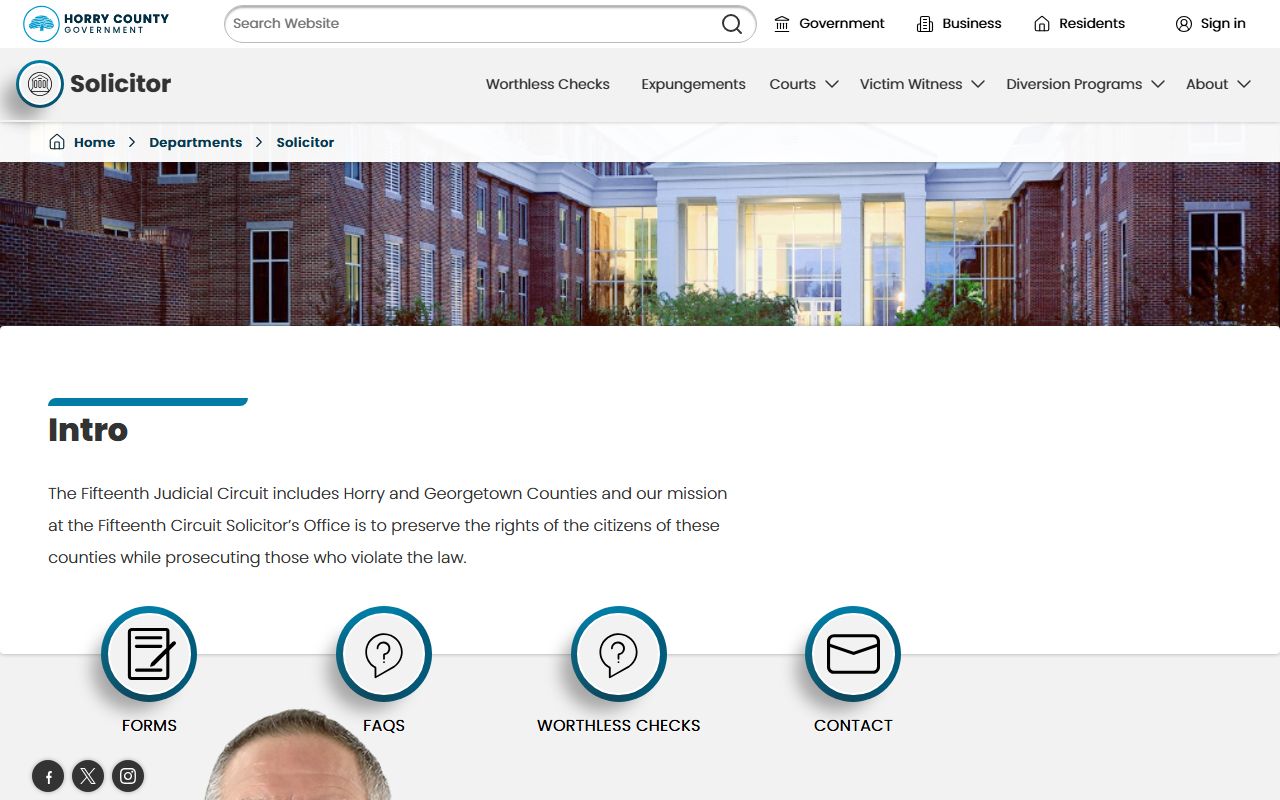
From that page a person can reach expungement help, victim services, and the office phone directory.
| Point | Charge | Conviction |
|---|---|---|
| Meaning | An accusation only | Guilt by plea or verdict |
| Who decides | Arresting agency / Solicitor | The court |
| Shown in | Arrest and booking record | Court disposition |
| Final? | No | Yes, unless appealed |
Note: a person booked and listed with charges may later be cleared, so never treat an arrest entry as proof of guilt.
Mugshots in Horry County Arrest Records
A mugshot is the booking photo taken when a person enters the jail. The Horry County bookings tool posts a mugshot for most arrests, pulled from the detention center image system. The photo appears in the result list and again in the record overlay.
Mugshots are public booking data, but they carry the same warning as the rest of the tool. The image marks an arrest, not a conviction. Horry County does not vouch for the accuracy of every posting. Mugshots can also drop off the public view once a person is released and the case moves on. For a lasting, official record of an outcome, you need a certified court disposition rather than a saved screenshot.
What Is Public and What Is Restricted
Most adult arrest and criminal court data in Horry County is open. South Carolina opens public records through the Freedom of Information Act in Title 30, Chapter 4 of the state code. The law says public business should be done openly and at low cost. But arrest data is not fully open. Several record types are closed or redacted by law.
Juvenile cases run through Family Court and are not ordinary public files. Adoption and mental health commitment records are closed. Sealed and expunged matters do not show in the public index or the criminal history at all. Personal data like Social Security numbers and account numbers is redacted under the Family Privacy Protection Act. As of January 1, 2026, home addresses no longer appear on the state Public Index.
- Open: adult bookings, mugshots, charges, and most General Sessions case data.
- Restricted: juvenile records, handled in Family Court.
- Closed: adoption files and mental health commitments.
- Removed: sealed or expunged records and redacted personal data.
The South Carolina FOIA statute sets the right to inspect and copy public records unless an exemption applies. A file with mixed data may come to you partly blacked out rather than withheld in full.
State Criminal Records Through SLED
The county tools show local arrests, but a full statewide criminal history comes from the state. The South Carolina Law Enforcement Division, known as SLED, keeps the state criminal-history system and the sex offender registry. A SLED criminal-history check is a separate product from the booking tool, the Public Index, or a Sheriff records check.
SLED is the source most employers and licensing boards point to for a formal background check in South Carolina. Its records reach beyond a single county.
The state law enforcement portal anchors Horry County arrest records to the wider South Carolina criminal-history system, well past any one county jail. You can start at the SLED website to see the state's law enforcement and records services.

From SLED a requester can reach statewide criminal-history and registry tools that a county booking search cannot match.
The Solicitor and Public Defender
Two offices sit on opposite sides of a Horry County criminal case. The Solicitor prosecutes. The Public Defender represents people who cannot afford a lawyer. Both serve Horry and Georgetown Counties in the Fifteenth Circuit.
Solicitor Jimmy Richardson runs the prosecution office at 1301 Second Avenue in Conway. The office schedules cases, charges defendants, and runs a Victim Witness Program. The victim-witness page explains victim rights, the impact statement, and case notifications. A victim impact statement becomes an official court document in the defendant's permanent file.
The victim-witness side of Horry County arrest records gives crime victims a voice from charging through sentencing. The office assigns a victim advocate to help through the process.
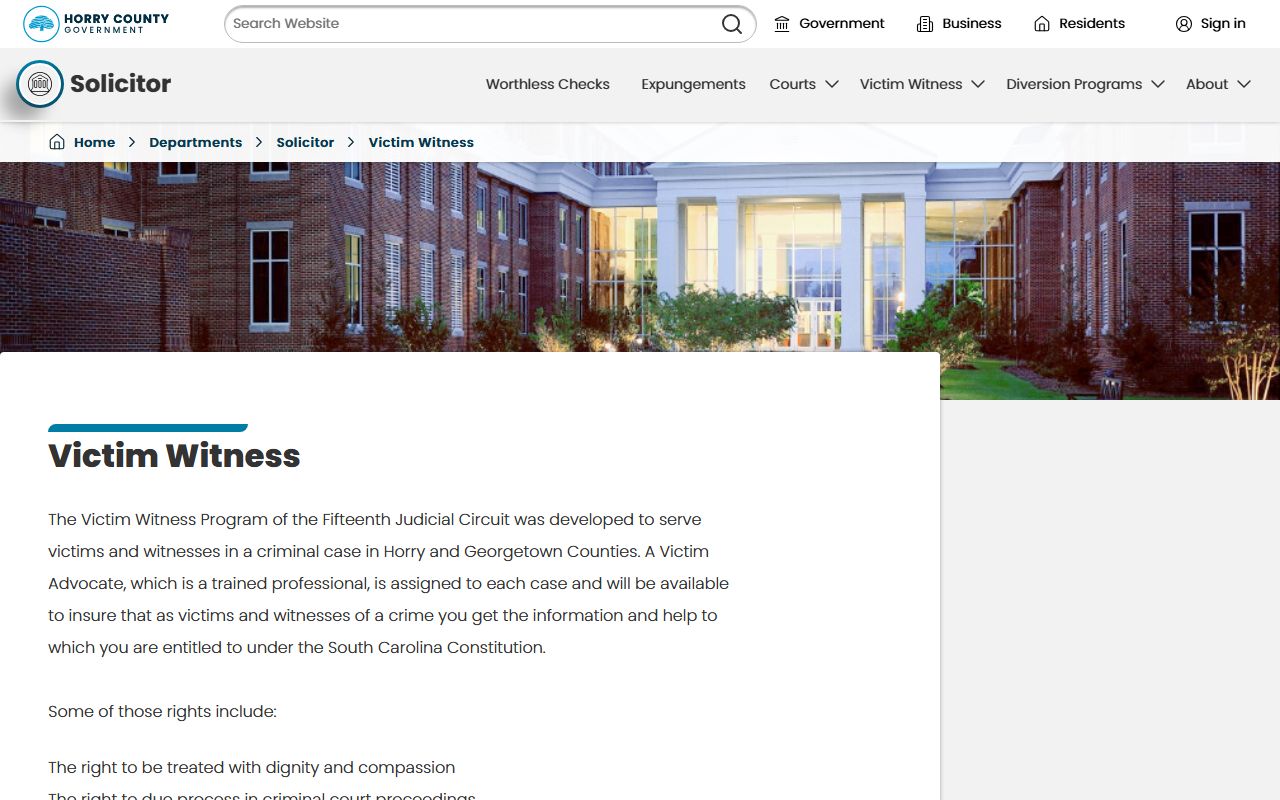
That page lays out how a victim gets notice of hearings, dispositions, and any restitution.
The Fifteenth Circuit Public Defender, led by Ronald Hazzard, represents indigent adults in criminal court and juveniles in Family Court. The office takes about three weeks after an application before it sends a letter naming the assigned attorney. The Public Defender does not schedule cases or gather evidence; the Solicitor does.
The Public Defender's role in Horry County arrest records is to protect the rights of people charged who cannot pay for private counsel. The office handles both adult and juvenile appointments.
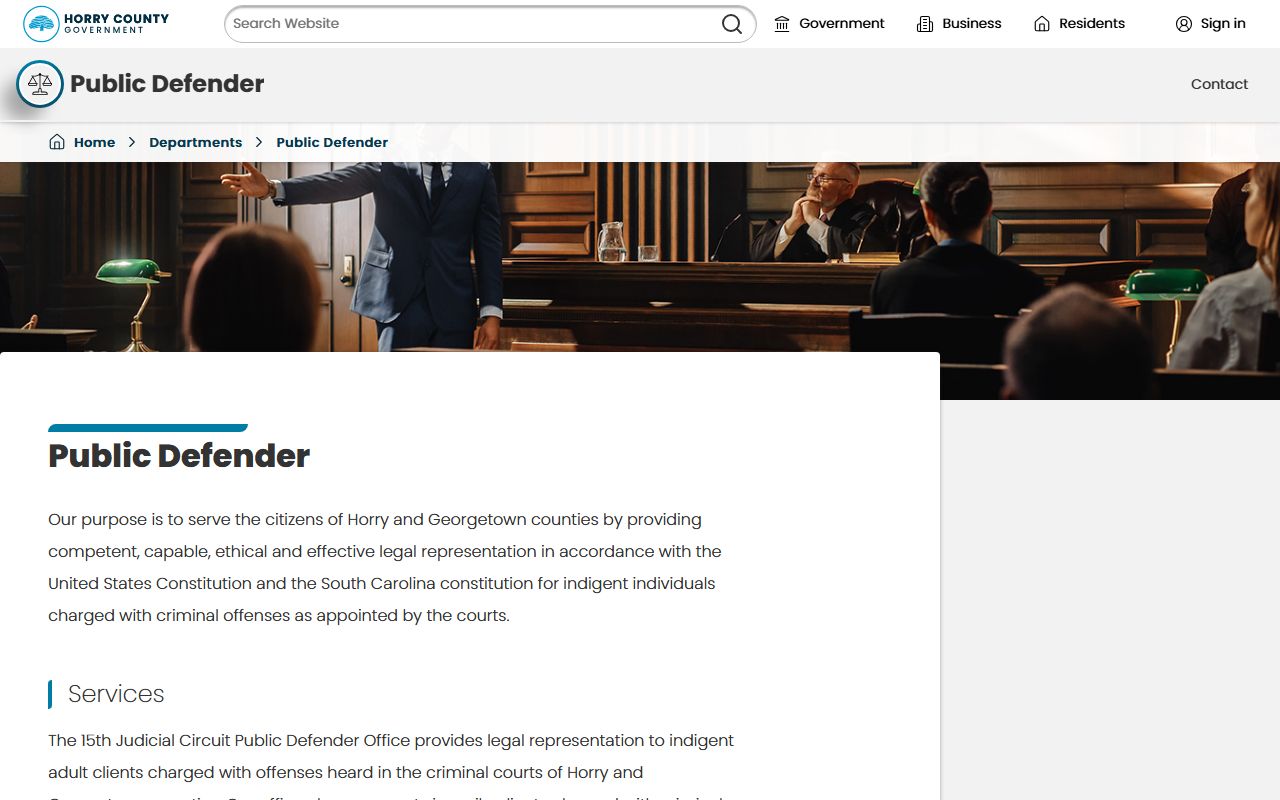
The page links the Horry application and explains the three-week wait for an attorney letter.
Note: the Public Defender only covers eligible appointed criminal and juvenile matters, so civil litigants need legal aid or private counsel instead.
Expungement Through the Solicitor
An expungement removes an eligible record from the public criminal history. In Horry County the process runs through the Fifteenth Circuit Solicitor's Office, not the jail and not the clerk. The Solicitor expungement page screens eligibility and links the Horry County screening and fee payment.
Not every old or dismissed case qualifies. Eligibility is category-specific under Title 17, Chapter 22 of the state code and related statutes. A first-offense magistrate or municipal conviction may qualify under S.C. Code § 22-5-910. A youthful-offender first offense may qualify under § 22-5-920, which the Solicitor applies when the person was under 25, the crime was non-violent, and there were no other convictions for five years after the sentence ended. Juvenile expungements run under § 63-19-2050 and are all handled at the Horry County Solicitor's Office.
The expungement screening side of Horry County arrest records decides whether a charge can be wiped from public view. A screener checks the offense type, the disposition, and any waiting period.
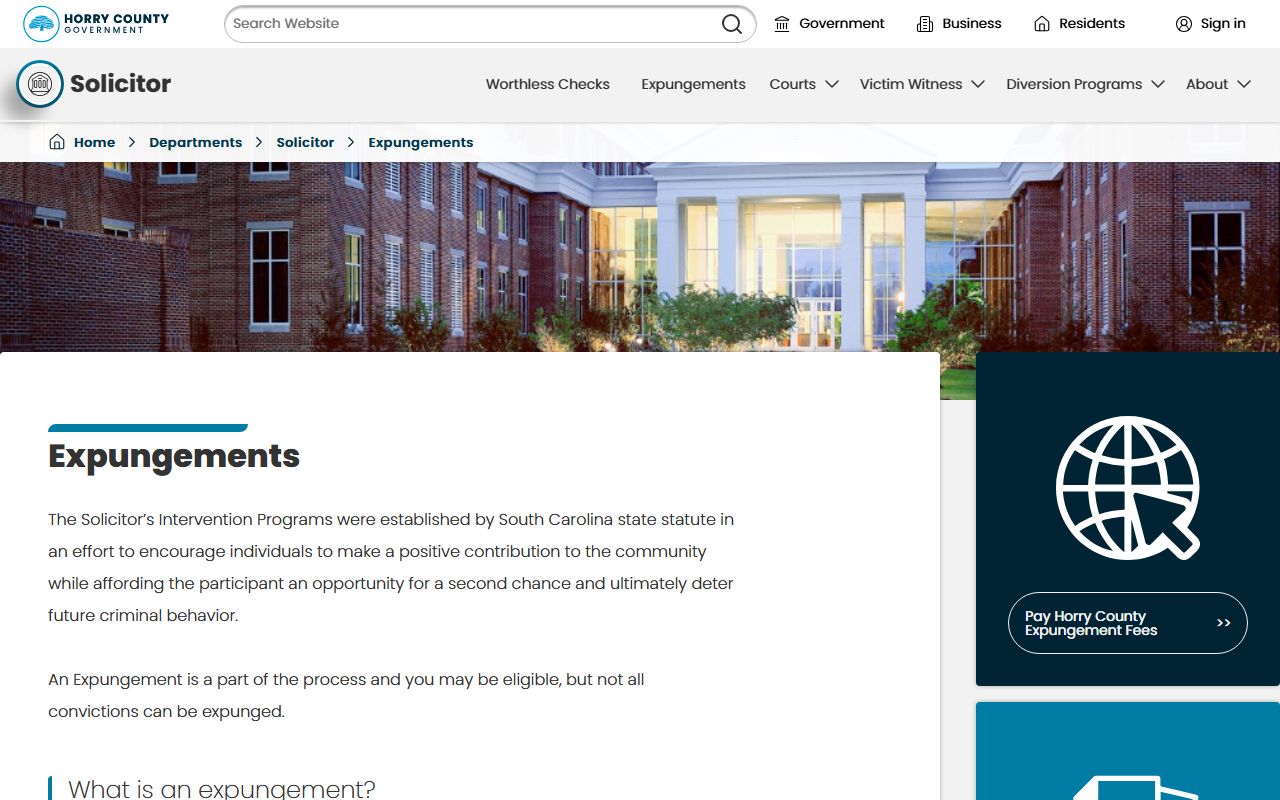
The page lists the eligible categories and the code sections that control each one.
- Screen your eligibility with the Solicitor's Office.
- Gather the case number and the court disposition.
- Complete the expungement application.
- Pay the required SLED, solicitor, and court fees unless exempt.
- Wait for agency review and a signed court order.
Common denials come from a non-qualifying offense, a new conviction during the waiting period, pending charges, a missing disposition, unpaid fees, or applying in the wrong county.
Sealed vs Expunged Records
These two terms get used as if they mean the same thing. They do not. A sealed record still exists but is hidden from ordinary public access, often by court order. An expunged record is removed or destroyed under the expungement statutes, so it should not appear in a public criminal history at all.
| Point | Sealed Record | Expunged Record |
|---|---|---|
| Status | Exists but hidden | Removed or destroyed |
| How it happens | Court order, often Rule 41.1 | Title 17 Ch 22 process |
| Who handles it | The court | The Solicitor's Office |
| Shows in Public Index | No | No |
To view a sealed record, a person usually needs a court order. Sealed civil settlements fall under South Carolina Rule of Civil Procedure 41.1. Sealed criminal, juvenile, or medical material may rest on other statutes, so one sealing rule does not control every record type.
Background Checks and Horry County Arrest Records
People often want arrest data for a job, a lease, or a license. The public booking tool and the Public Index are useful, but they are not a certified background check. A formal check usually needs a SLED criminal-history product or a certified court disposition from the Clerk of Court.
This is also where federal cases come in. Serious federal crimes are handled by the U.S. Attorney's Office for the District of South Carolina, which includes a Florence contact. Federal charges do not show in the county jail tool or the state Public Index. They live in the federal court system.
The federal prosecution side of Horry County arrest records covers crimes charged in U.S. District Court rather than state court. These cases sit entirely outside the county and state portals.
For a federal case a requester checks the federal court and PACER, not the county bookings app.
Note: This site is not a consumer reporting agency, and these records cannot be used for credit, employment, tenant, or other FCRA-regulated decisions.
How to Read a Horry County Arrest Record
Arrest records use shorthand that can confuse a first-time reader. A few quick definitions clear up most of it. The terms below show up across booking data and criminal court files.
- Booking
- The intake event when a person is processed into the jail.
- Charge
- An accusation tied to a statute, not a finding of guilt.
- Bond
- Money or conditions set for release before trial.
- Bench warrant
- A warrant a judge issues, often for a missed court date.
- Disposition
- The final outcome of a charge or case.
- Expungement
- The legal removal of an eligible record from public history.
A charge with "NO BAIL SET" usually means a magistrate could not set bond, often for the most serious offenses. Magistrate judges cannot set bond for murder or certain sex crimes against minors; a Circuit Court judge handles those in General Sessions. For an active warrant tied to an arrest, see the Horry County warrant records page.