
The Horry County Probate Court
The Horry County Probate Court is led by Judge R. A. Beverly Jr. The office sits on the second floor of the courthouse at 1301 Second Avenue in Conway. This court is county based, not run by the state. The probate judge is elected to a four-year term and handles a set list of matters fixed by law.
Probate covers more than just wills. The court opens and oversees the estate of a person who has died. It also handles the estate of a minor or an incapacitated adult, sets up trusts when ordered, and rules on involuntary commitments. Guardianship and conservatorship cases run through this court too. On top of all that, the Probate Court issues marriage licenses for the county. Some probate matters can even go to a jury trial.
To open an estate in person, you must schedule an appointment first. You can call the office or email to set a time. Walking in without an appointment will not get an estate opened.
The state judiciary keeps a plain page that explains what each county probate judge does. See the South Carolina Probate Court overview for the statewide framework.
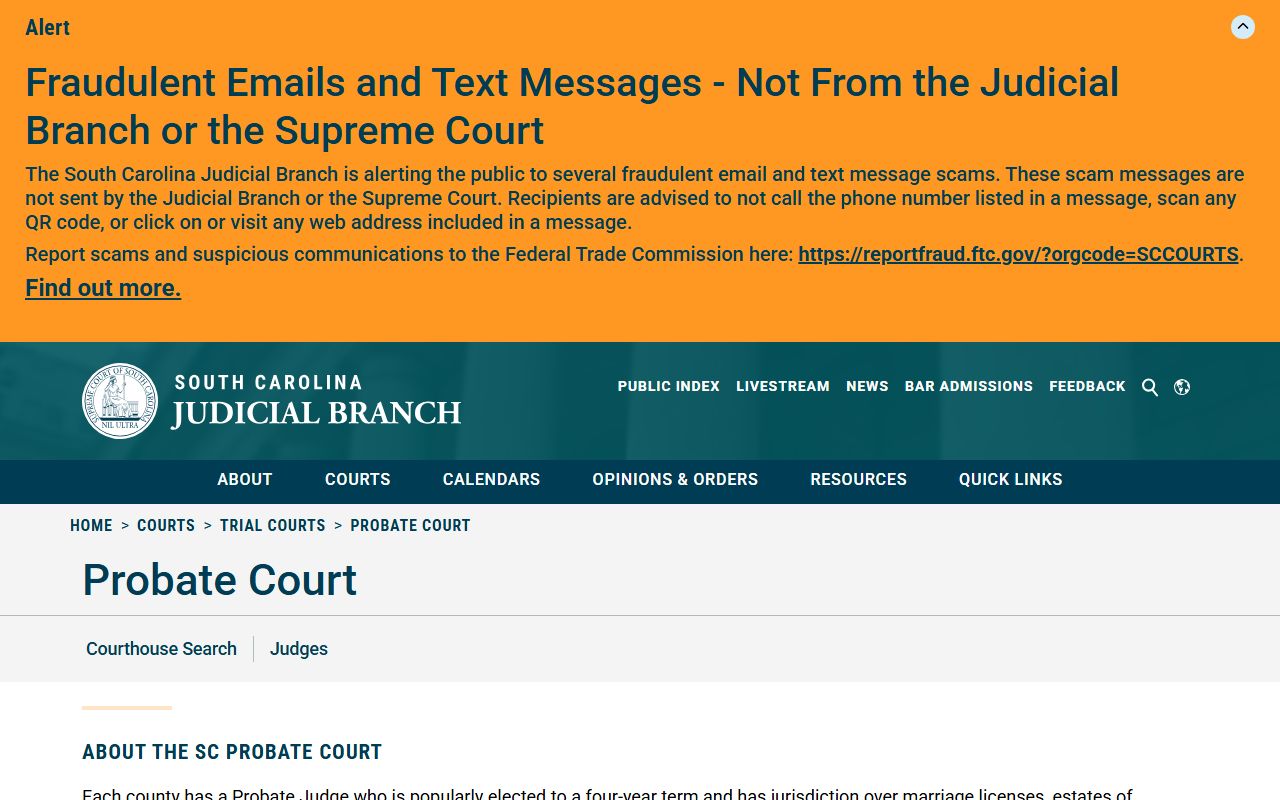
That state page lists the four-year term, the estate role, and the marriage and guardianship duties that every county probate court shares.
Horry County Probate Court Contact and Hours
Use the card below to reach the Probate Court. The mailing address and the physical address are not the same, so check which one you need. Mail goes to the P.O. Box. Visits and appointments happen at the Second Avenue courthouse.
Horry County Probate Court
1301 Second Avenue, 2nd Floor
Conway, SC 29526
Mail: PO Box 288, Conway, SC 29528-0288
843-915-5370
Fax: 843-915-6371
To email the court, write to hcg.ProbateCourt@horrycountysc.gov. Use that address to ask for an appointment or to ask a question the website does not answer. The phone line is the fastest way to confirm what to bring before you come in.
Note: Always call ahead to confirm office hours and appointment rules before you visit the courthouse.
What Horry County Probate Records Cover
Probate records in Horry County reach across many kinds of cases. The core is the estate of a person who has died, with or without a will. But the court holds a much wider set of files. The list below shows the main groups that the Probate Court keeps.
Each file type leaves its own record. Some are open to the public. Others, like commitment files, are closed by law and need a court order to view.
- Estates of the deceased - wills, applications, inventories, and closing papers.
- Guardianships - care and personal choices for an incapacitated person.
- Conservatorships - money and property for someone who cannot manage it.
- Trusts - trust matters the court is asked to oversee.
- Involuntary commitments - mental health and substance cases, closed by law.
- Minor settlements - court approval of money paid to or for a minor.
- Marriage licenses - the county marriage license record.
Marriage and divorce records split between two offices here. Marriage licenses come from Probate Court, but divorce is a Family Court matter. For that side, see the Horry County marriage and divorce records page.
Marriage Licenses Through Horry County Probate
The Probate Court issues marriage licenses for Horry County. There is a 24-hour waiting period between when you apply and when the court can issue the license. You can apply in person, and some steps can be done by mail. Both parties need proper ID and a Social Security card under the court's rules.
The license process is its own track and is not part of an estate file. Still, it lands in the same office and shows in the marriage record. The state marriage law sets the license requirement and the 24-hour rule.
The county posts the full marriage license steps, the fees, and the ID rules online.
For the official walkthrough, see the Horry Probate marriage license page.
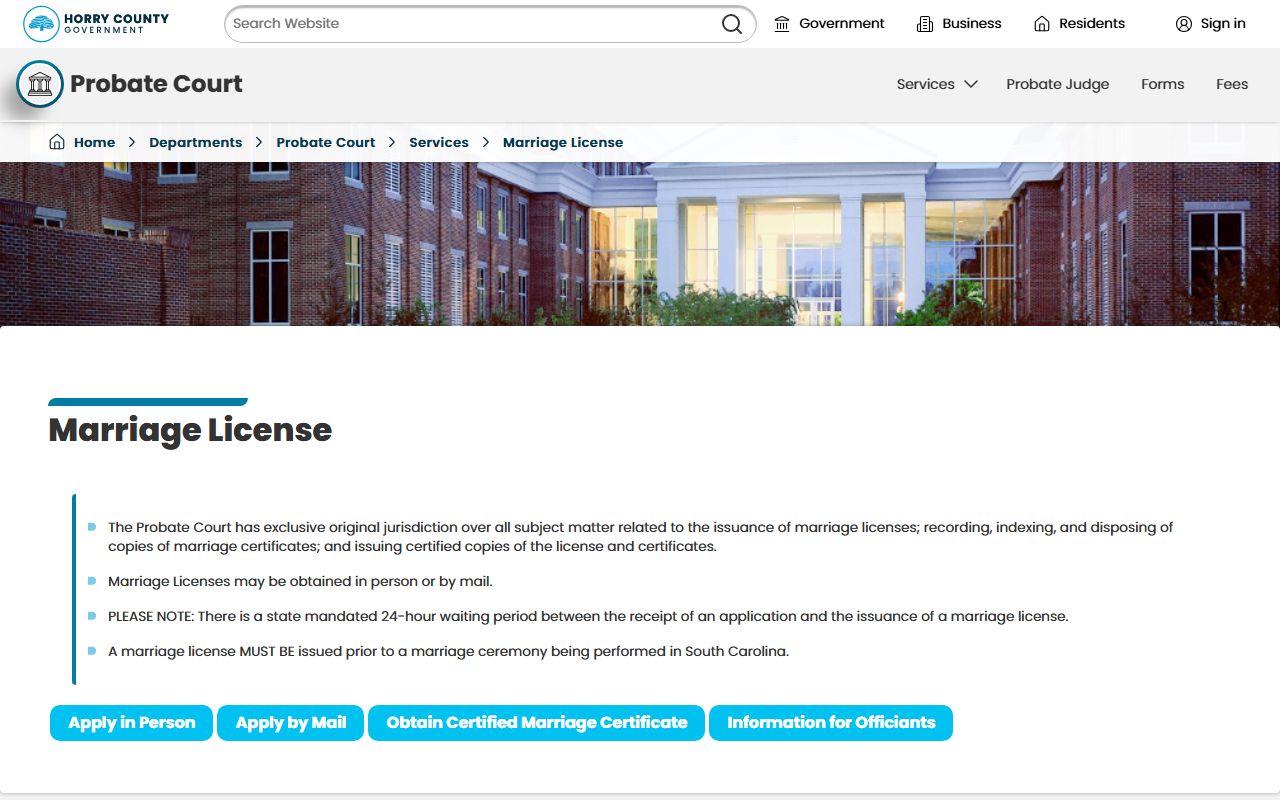
That page spells out the 24-hour wait, the in-person and mail steps, the fees, and the ID and Social Security card rules.
Opening an Estate in Horry County
To open an estate in person, you must set an appointment first. Call 843-915-5370 or email the court to schedule a time. The court will tell you what to bring. This rule keeps the process orderly and cuts down on missing paperwork.
If the person who died left a will, that original will must be filed with the court within 30 days of the date of death. This is a firm deadline. Filing the will does not by itself open the estate, but it is a required step. The court can index a will under its own fee even when no full estate is opened right away.
Most estates in Horry County use informal procedures. That means no notices or hearings are needed unless an interested party demands one. The demand right comes from S.C. Code § 62-3-204, part of the state Probate Code. Formal administration adds notice and hearing steps and is used when there is a dispute or a special need.
The county page gives the jurisdiction list, the will deadline, and the appointment rule in one place.
You can review the Horry County Probate Court page for the office basics.
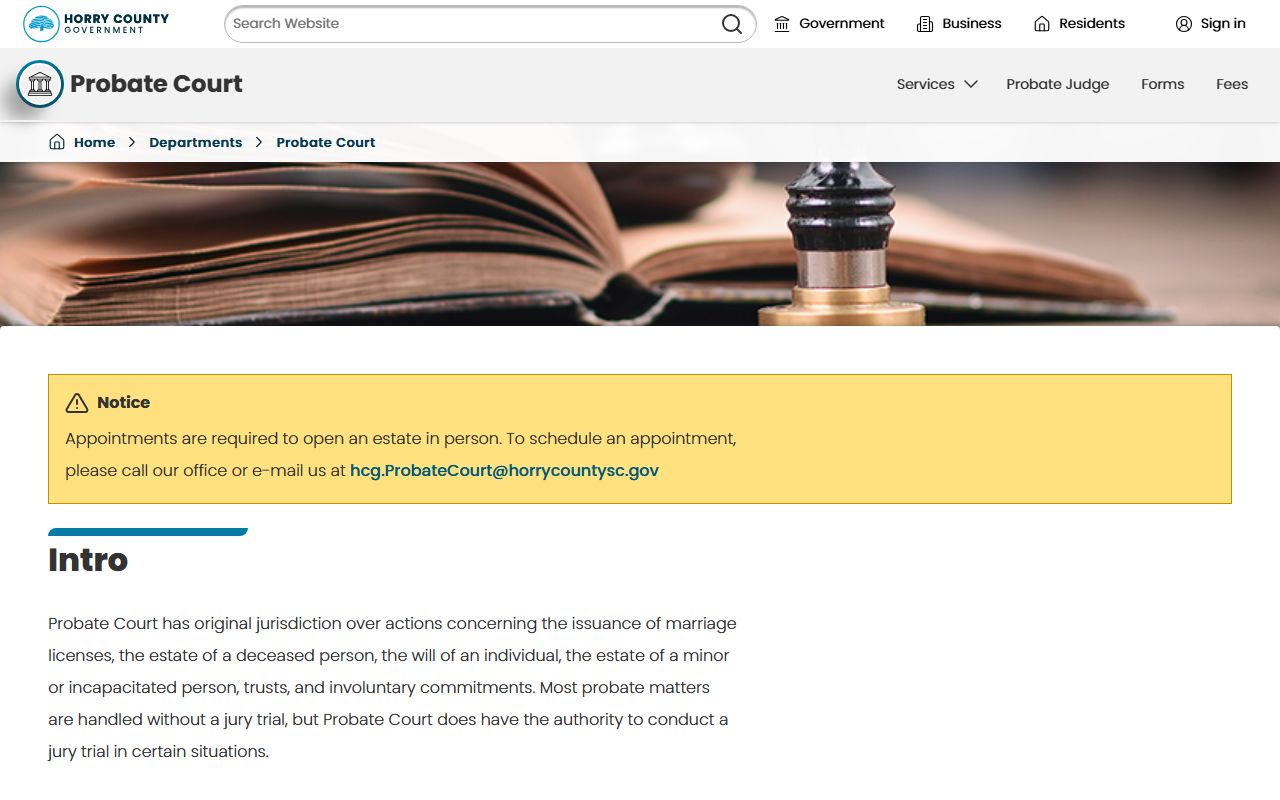
From there you can confirm the appointment requirement, the jurisdiction list, the 30-day will rule, and the guardian and conservator summary.
Informal Versus Formal Estate Administration
South Carolina sorts estate work into two tracks. The informal track is the common one. The formal track adds court oversight. Which one applies depends on the estate and on whether anyone asks for a hearing.
In the informal track, the court appoints a personal representative without a hearing in most cases. There are no required notices unless an interested party demands them. This keeps simple estates fast and cheap. Many families never need to set foot in a courtroom. The formal track kicks in when there is a will contest, a fight over who serves, a question about heirs, or any matter that needs a judge to rule. Formal cases bring notice to interested parties and one or more hearings. The same Probate Code section that lets a party demand notice, § 62-3-204, is what can push an estate from informal toward formal handling.
Talk to the court if you are not sure which track fits. The staff cannot give legal advice. But they can point you to the right forms and tell you the fee.
How to Search Horry County Probate Records
The Probate Court links a separate online tool called Public Inquiry. This is not the same as the statewide Public Index used for Circuit and Family Court cases. The Public Inquiry portal is meant for estate and probate lookups. You can reach it at scportal.hostedbyspartan.com.
Search results online may be limited. Not every file shows up, and access can vary. If a file does not appear in Public Inquiry, call Probate Court at 843-915-5370. Staff can check the record and tell you what is on file. For a certified copy, you will order it from the court and pay the copy fee.
Keep in mind that probate is a different system from the main court case search. People often mix the two up. For general court cases, the state runs a free Horry County Public Index. For estate and guardianship files, the probate Public Inquiry portal is the right starting point.
Common Horry County Probate Terms
Probate files use words that do not come up in daily life. The short list below covers the terms you will see most. Knowing them makes a file far easier to read.
- Testator
- A person who dies leaving a valid will.
- Executor
- The person named in a will to settle the estate.
- Intestate
- Dying without a valid will, so state law decides who inherits.
- Personal Representative
- The person the court appoints to administer an estate, with or without a will.
- Guardianship
- Court authority to make care and personal choices for an incapacitated person.
- Conservatorship
- Court authority to manage the money and property of a person who cannot.
Incapacity can come from mental illness, physical illness, age, or chronic alcohol or drug use, among other causes. A guardian decides where the ward lives and handles care, comfort, and health choices.
Horry County Probate Court Fees
Estate filing fees are tied to the value of the estate. The more the estate is worth, the higher the fee. Copy fees and other filing fees are set apart from the value tiers. The table below shows the official Probate Court fees. Always confirm the current amount before you pay.
| Item | Fee |
|---|---|
| Estate value less than $5,000 | $25 |
| $5,000 to less than $20,000 | $45 |
| $20,000 to less than $60,000 | $67.50 |
| $60,000 to less than $100,000 | $95 |
| $100,000 to less than $600,000 | $95 plus 0.15% of value over $100,000 |
| $600,000 or higher | Above amount plus 0.25% of value over $600,000 |
| Certified copy | $5 plus $0.50/page |
| Exemplified/authenticated copy | $20 plus $0.50/page |
| Photocopy/microfilm | $0.50 |
| Filing/indexing will under § 62-2-901 | $10 |
| Reopening closed estate | $22.50 |
| Annual Conservator Report | $10 |
| Affidavit for Collection, $100 to less than $5,000 | $25 |
| Research fee | $10 |
The county also charges newspaper publication fees when notice to creditors must run, and those rates differ by paper. The official fee page lists the full schedule.
See the Horry Probate Court fee schedule for estate, copy, affidavit, marriage, and publication fees.
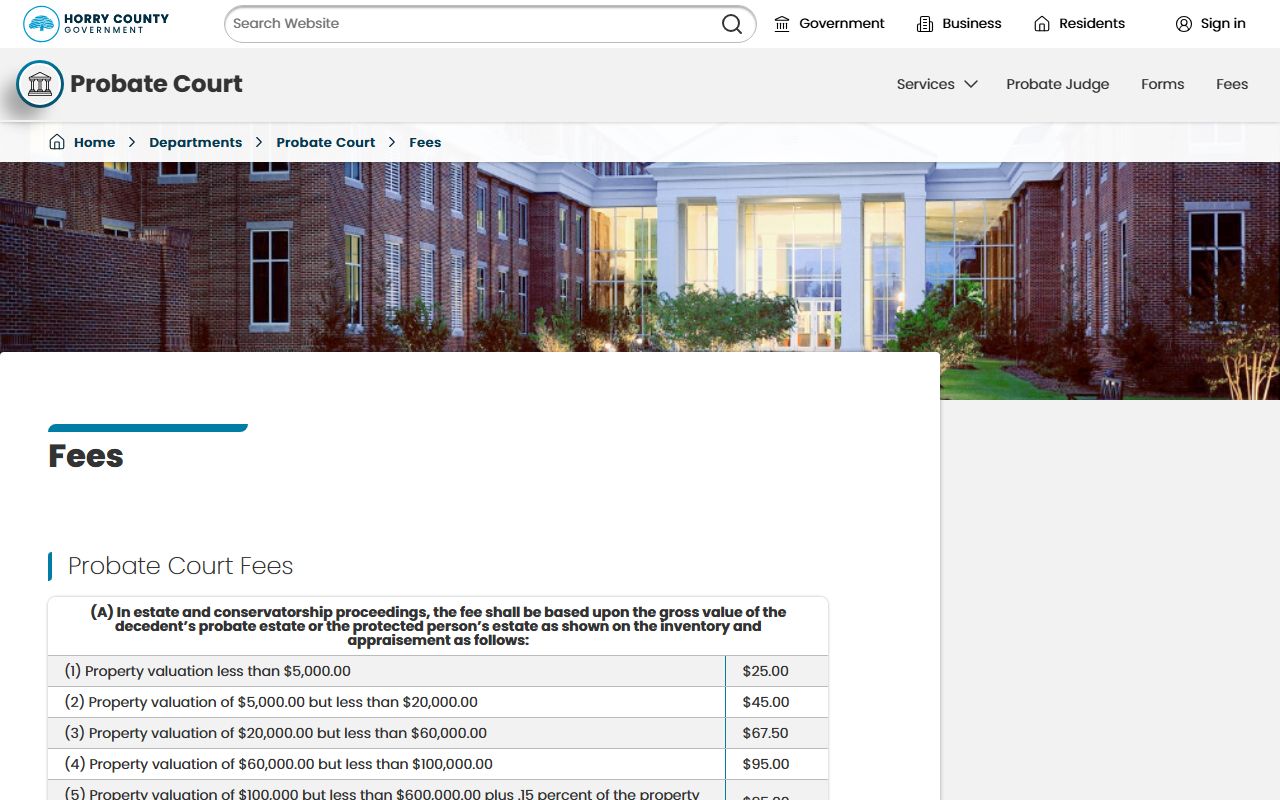
That page breaks out the estate value tiers, the copy fees, the affidavit for collection amounts, and the newspaper publication rates.
How Horry County Probate Works Step by Step
Estate administration follows a set path. The steps below show the usual order for a Horry County estate. Some steps may not apply to a small or simple estate. The court can tell you which ones you can skip.
- File the original will within 30 days if the person left one.
- Schedule an appointment to open the estate in person.
- Decide on informal or formal administration; most estates are informal unless a party demands a hearing.
- File the application or petition and the required forms, then pay the filing fee based on estate value.
- The court issues fiduciary letters once the personal representative is appointed.
- Publish notice to creditors if required and pay the newspaper fee.
- File the inventory and appraisement and any required reports.
- Handle creditor claims, taxes, and the sale, transfer, or distribution of property.
- File the accounting and closing documents and get the discharge.
The full Probate Code that governs these steps is in state law. You can read the estate administration rules in Title 62, Chapter 3 of the South Carolina Code.
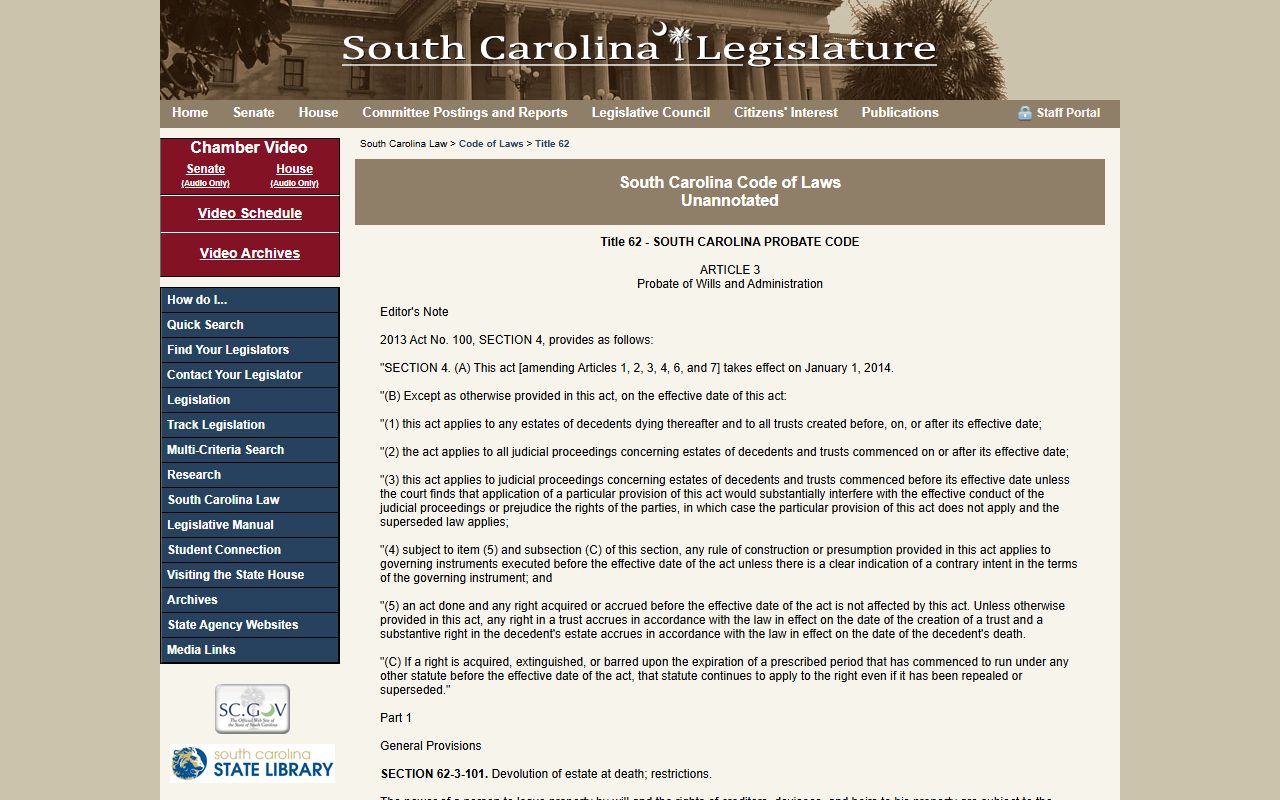
That code chapter lays out the informal and formal tracks, the role of the personal representative, and the demand-for-notice right under § 62-3-204.
Guardianship and Conservatorship in Horry County
When an adult cannot make safe choices, the court can step in. A guardian handles personal and custodial matters. A conservator handles money and property. The two roles can be split between people or held by one person.
Incapacity is not one thing. It can come from mental illness or deficiency, a physical illness or disability, advanced age, chronic alcohol or drug use, or any cause that impairs a person's ability to make responsible decisions. The court weighs the evidence before it acts. A guardian then decides where the ward lives, arranges care and comfort, and makes medical and health care choices. A conservator files reports, such as the Annual Conservator Report, to show how the money is handled.
These cases need specific forms and, often, a physician's affidavit. The court can give you the right packet. Many people use a lawyer for a contested guardianship.
Involuntary Commitments in Horry County
The Probate Court also handles involuntary commitment cases. These come up when a person who is mentally ill, an alcoholic, or a drug addict has lost self-control and is likely to harm themselves or others. The first step is not the court.
Before you go to Probate Court, contact the Waccamaw Center for Mental Health for an assessment. That step comes first by design. The center evaluates the person and helps decide what care is needed. Commitment files are closed by law, so they do not show in any public search. A court order is needed to access them. If you face a true emergency, call 911 or local crisis services rather than waiting on the court process.
Note: Commitment records are confidential and sealed by law; the public cannot view them without a court order.
Horry County Probate Records Questions
How do I open an estate in Horry County?
Schedule an appointment with the Probate Court first. Call 843-915-5370 or email the office. If there is a will, file the original within 30 days of death. Bring the forms and fee the court tells you to bring.
How can I search Horry County probate records?
The court links a Public Inquiry portal for estate and probate lookups. It is separate from the statewide Public Index. If a file does not show, call Probate Court at 843-915-5370 and staff can check the record for you.
What does an estate filing cost?
The fee depends on the estate value. It starts at $25 for estates under $5,000 and rises by value tier. A certified copy is $5 plus $0.50 per page. Confirm the current fee with the court before you pay.
For more answers across all record types, see the Horry County court records FAQ page.