
How to Search Horry County Traffic Court Records
Most Horry County traffic court records start with the state ticket tool. The South Carolina Judicial Branch Traffic Ticket Search lets you look up a summary-court ticket by citation number, by driver's license, or by name and date of birth. The state describes it as a way to pay a traffic ticket issued in a summary court in South Carolina. Some municipal court tickets show there too. For fuller case detail, the free Horry County Public Index covers magistrate and several municipal courts.
Have the citation in hand before you search. The citation number is the fastest path. If you do not have it, a name search needs a date of birth to match the right driver. The county's online services hub links ticket payments and court rosters in one place, so you do not have to dig through menus.
| Field Label | Type | Required | Notes |
|---|---|---|---|
| Search by Citation | Tab / route | Optional route | Use if the citation or ticket number is available. |
| Citation Number | Text | Conditional | Exact citation number; shown as the primary search. |
| Search by Driver's License | Tab / route | Optional route | Use if the license number is available. |
| Driver's License | Text | Conditional | Enter the driver's license number. |
| State | Dropdown | Conditional | License issuing state; all states generally available. |
| First Name / Last Name | Text | Conditional | Name search fields. |
| Date of Birth | Date picker | Conditional | Required for a name search to identify the driver. |
| Search / Submit | Button | – | Runs the ticket search. |
If a ticket does not show up online, the court may not have uploaded it yet. The city may not take part in the state system. The citation number may have been typed in a different way. In that case, call the court that issued the ticket.
Which Courts Handle Traffic Cases in Horry County
Traffic tickets in Horry County land in a summary court. That can be the county magistrate or central traffic court, or one of the city municipal courts. Where the ticket goes depends on who wrote it and where. A state trooper or county deputy ticket usually routes to the central traffic court. A city officer ticket inside town limits goes to that city's municipal court.
The county's main traffic operation is the Central Traffic Court, tied to the Conway Magistrate. Seven Horry municipalities appear on the statewide Public Index list: Atlantic Beach, Aynor, Conway, Loris, Myrtle Beach, North Myrtle Beach, and Surfside Beach. The table below gives the address and phone for each main traffic court, pulled from county and court sources.
| Court / Route | Address | Phone |
|---|---|---|
| Central Traffic Court / Conway Magistrate | 1201 Third Avenue, Conway, SC 29526 | 843-915-5070 |
| Myrtle Beach Municipal Court | 1101 Oak Street, Myrtle Beach, SC 29577 | 843-918-1356 |
| North Myrtle Beach Municipal Court | 1015 2nd Avenue South, North Myrtle Beach, SC 29582 | 843-280-5520 |
| Conway Municipal Court | 229 Main Street, Conway, SC 29523 | 843-248-1765 |
| Surfside Beach Municipal Court | 210 U.S. Highway 17 South, Surfside Beach, SC 29575 | 843-913-6338 |
| Atlantic Beach Municipal Court | 717 30th Avenue South, Atlantic Beach, SC 29582 | 843-663-2284 |
| Aynor Municipal Court | 600 South Main Street, Aynor, SC 29511 | 843-358-6231 |
| Loris Municipal Court | 3817 Walnut Street, Loris, SC 29569 | 843-756-6674 |
Magistrate courts also set bail, issue warrants, and handle minor crime. To read more about that court, see the Horry County Magistrate Court page. The state explains summary-court limits on its municipal court page.
Note: a traffic case may not appear online if the city does not take part in the statewide case system, so check the listed court directly.
Types of Traffic Cases on Record
Traffic records cover a wide range of charges. Most are simple payable tickets. Some are far more serious and can route as criminal matters. The kind of case shapes where the record sits and how it gets handled. A speeding ticket and a DUI are not treated the same way.
Common Horry County traffic court records include speeding, running a light or sign, no insurance, driving under suspension, and equipment or registration offenses. Many of these are summary-court tickets. The more serious charges sit apart.
- Standard moving violations such as speeding or unsafe lane changes.
- Equipment, registration, and insurance offenses.
- Driving under suspension and license-related charges.
- Reckless driving and leaving the scene.
- DUI and DUAC, which route as criminal matters.
The state Family Court page notes that most traffic, fish, and game law violations stay triable in magistrate or municipal courts, even for juveniles. Serious criminal charges, though, may transfer to Circuit Court. Juvenile records may be restricted by case type.
What Horry County Traffic Court Records Show
A Horry County traffic court record holds the basic case facts plus a running log of court actions. The exact fields depend on the court and whether the case sits in the Public Index. Not every field shows on every ticket. The list below mirrors what Public Index materials surface for a traffic case.
| Field | What It Shows |
|---|---|
| Citation / Case Number | The ticket or court-assigned number for the case. |
| Court Agency | Central traffic court, magistrate, or a city municipal court. |
| Driver / Defendant | The name of the cited driver. |
| Charge / Statute | The violation description and statute or ordinance number. |
| Dates | Citation date, violation date, and the court date. |
| Law Enforcement | The agency or officer that wrote the ticket. |
| Financials | Fine, court costs, assessments, and payment status. |
| Disposition | Paid or guilty, not guilty, dismissed, reduced, or failure to appear. |
A record may also list the assigned judge, the disposition judge, docket actions, and document icons when images are posted. Home addresses came off the Public Index for all cases as of January 1, 2026.
Searching by Citation Number vs by Name
The Traffic Ticket Search gives you three routes to the same case. You can search by citation number, by driver's license, or by name with a date of birth. Each route fits a different starting point. Pick the one that matches what you hold in your hand.
The citation number is the cleanest match. It points straight to one ticket with no guesswork. A driver's license search needs the license number and the issuing state. A name search is the fallback when you have neither. Because many people share a name, the name route asks for first name, last name, and date of birth to pin down the right driver.
For broader case history, the Public Index lets you search by name, case number, court type, and date range. It can surface older traffic cases that the live ticket tool may not. To learn the full case-index workflow, see the Horry County court records page.
Paying or Contesting a Horry County Traffic Ticket
You usually have two choices on a traffic ticket. Pay it, or contest it in court. Each path has real consequences, so read the citation closely first. It names the court, the court date, the citation number, the violation, the fine, and whether you must appear in person. Paying a ticket is usually treated as resolving the case, and it may be treated as a conviction for driver-record and points purposes.
The steps below outline the general process. They are not legal advice. If you want to contest a charge, or if you hold a commercial license, talk to the court or a lawyer.
- Read the citation. Note the court name, court date, citation number, officer or agency, violation, fine, and whether you must appear.
- Search the state Traffic Ticket Search by citation number first. If it is not found, try the driver's license or the name and date of birth.
- If the search sends you to county payment, use the SC.GOV traffic tickets and court payments page and choose Horry when Horry is the ticketing county.
- If the ticket is municipal, check whether that city is in the state system. If it is not, contact the city's municipal court directly.
- To plead not guilty, follow the citation instructions and appear or contact the listed court before the court date.
- Do not miss court. A missed date can lead to a bench warrant, failure-to-appear consequences, or reporting that affects your license.
The SC.GOV payment page lists county-by-county payment links, with Horry among them, and the tool decides payment eligibility after you search.
Here is the SC.GOV page that routes traffic ticket payments by county.
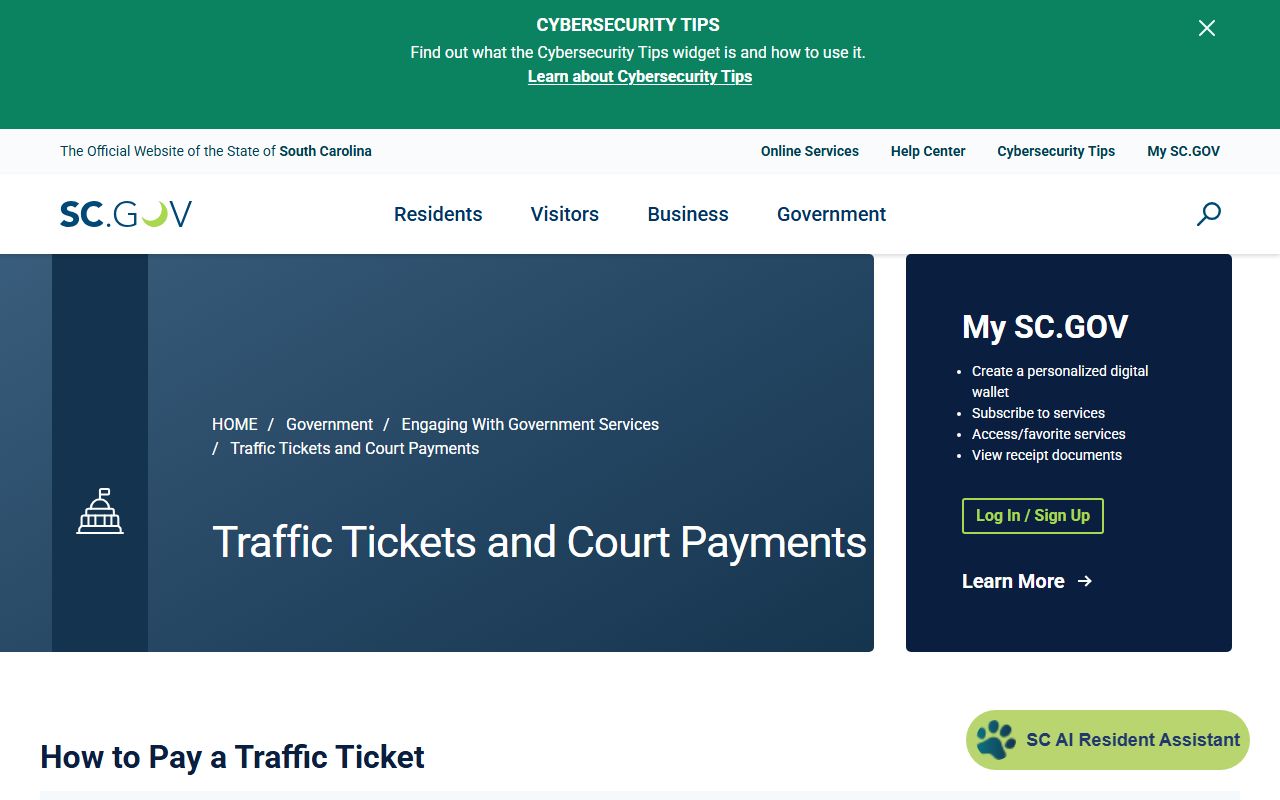
From that page you pick the right county and follow the link to pay or to find the proper court.
Public Access Laws for Traffic Court Records
South Carolina opens public records under the Freedom of Information Act, found in Title 30, Chapter 4. The law says public business should be done openly and that people can learn about it at low cost and little delay. Court traffic cases are open as a rule, though access usually runs through the Public Index or the issuing court rather than a formal FOIA request.
Access is not total. Personal data like Social Security and account numbers is shielded under the Family Privacy Protection Act. Juvenile records can be restricted by case type. Home addresses were removed from the Public Index for every case as of January 1, 2026.
Key Statutes:
S.C. Code § 30-4-30 - gives a person the right to inspect and copy public records unless an exemption applies.
S.C. Code Title 63, Chapter 19 - the Juvenile Justice Code, which limits access to many juvenile records.
Note: a traffic ticket in summary court is a court case file, while juvenile and sensitive matters may be closed, so not every record is open to anyone.
Court Traffic Records vs State Driver Records
People often mix up two different files. The court traffic record is the case file kept by the court. The state driver record is the licensing history kept by the SCDMV. They live in separate systems, serve different jobs, and update on different timelines. You may need to check both.
The court file tracks the citation, the court date, the charge, the fine, and the disposition. The SCDMV record tracks convictions reported to the DMV, license status, points, and suspensions. A conviction in court is what gets sent to the DMV and posted to the driver record. The table below lines the two up side by side.
| Item | Court Traffic Record | SCDMV Driver Record |
|---|---|---|
| Custodian | Summary, magistrate, or municipal court; Public Index and Traffic Ticket Search | South Carolina Department of Motor Vehicles |
| Purpose | Tracks the citation, court date, charge, fine, and disposition | Tracks driver history, reported convictions, license status, and points |
| Search path | Citation number, license, name and DOB, Public Index, court roster | SCDMV driving-record request or free points summary |
| Certified copy | Court clerk for the court file and disposition | SCDMV for the driving record |
| Updates | Court enters disposition and payment; timing depends on the court | DMV posts convictions after the court reports them |
| DUI / serious traffic | May appear as a criminal or traffic court case | May show a mandatory suspension; DUI is not merely a points matter |
So a clean court search does not always mean a clean driver record, and the reverse is also true. Check the file that fits your need.
The SCDMV driving-record page shows how to view your own record.
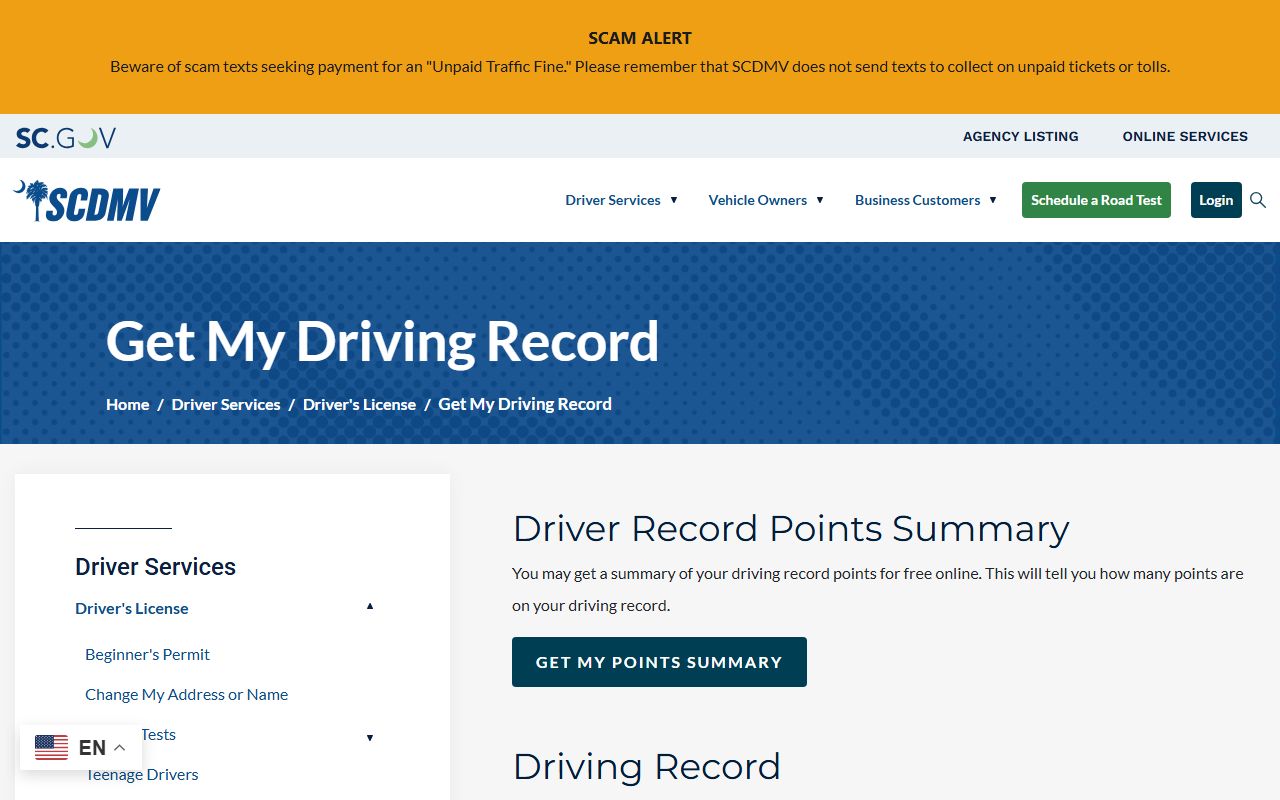
The SCDMV page lets you pull a free points summary online and request a full record by mail using Form MV-70.
CDL and Commercial Driver Records
Commercial license holders face stricter rules. A CDL holder can face commercial-driver consequences from a traffic conviction, and those consequences may apply even when the person was driving a noncommercial vehicle at the time. That makes a CDL ticket a bigger deal than a regular one.
Because of that risk, a CDL holder should not just pay a ticket without thinking it through. The better step is to consult the court or a lawyer before deciding how to handle the charge. The court file and the SCDMV record both matter here. A conviction reported to the DMV can affect license status in ways that go beyond a simple fine.
The SCDMV points system page explains how convictions are reported and posted to the driver record.
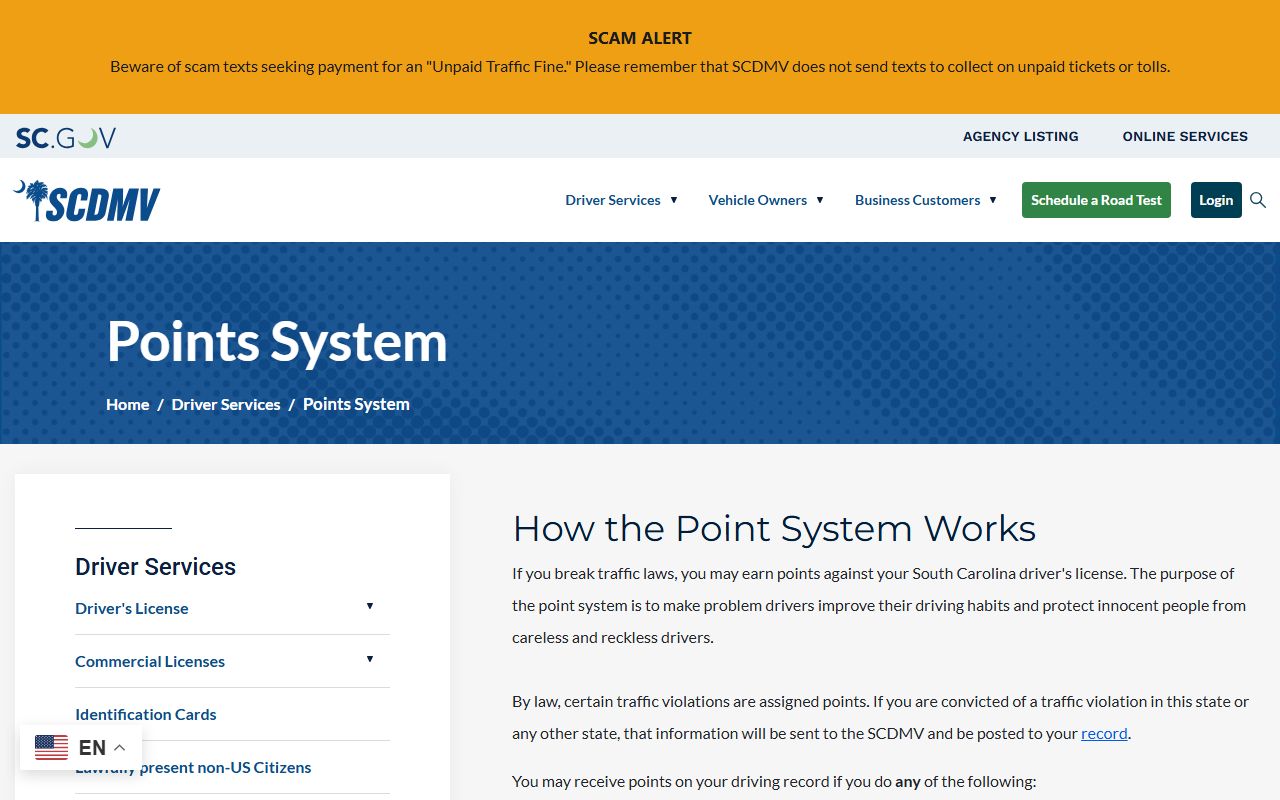
That page also notes that some violations, such as DUI, carry a mandatory suspension and sit outside the point system.
DUI / DWI Cases
DUI and DUAC are not simple payable tickets. They route as criminal matters and trigger a mandatory license suspension under SCDMV rules. DUI is not handled inside the point system the way a speeding ticket is. The suspension can apply on its own.
Because these cases are criminal, they show up differently in the court system and carry far heavier stakes. For arrest and criminal-case detail tied to a DUI, see the Horry County arrest records page. Reckless driving, driving under suspension, leaving the scene, and serious injury or death cases may follow a similar criminal path.
Sealing or Expunging Traffic Records
Whether a traffic record can be sealed or expunged depends on the offense and the disposition. There is no blanket rule that wipes every ticket. Eligibility for criminal or traffic-related charges runs through a screening process, not an automatic deletion.
The Fifteenth Circuit Solicitor's expungement page screens eligibility under Title 17, Chapter 22 and related statutes. Keep in mind that an expungement of a court charge is a separate thing from fixing or updating the SCDMV driver record. For driver-record questions, the SCDMV is the right office. For the court file, work through the issuing court or the solicitor's screening.
Note: sealing or expunging a charge does not automatically change what the SCDMV shows, so handle the driver record through the DMV.
Fees for Traffic Record Copies
A traffic ticket's fine and court cost are set by the citation itself. The amount is specific to that charge, and the state portal works out the payment eligibility and amount after you search. For that reason, there is no single Horry traffic fine schedule to publish here. The number on your citation is the number that counts.
For a certified copy of a court disposition, use the issuing court or the Clerk or Magistrate office that holds the file. An exact certified-copy fee for a traffic file was not found in official sources, so call ahead. The Horry County Clerk of Court page covers how to request certified court copies. For the driver record, the SCDMV offers a free online points summary and a mailed record by request.
One more pointer. The detention bond page notes that some bondable pay offenses, called Cash and Dash, let an offender pay without going before a magistrate, but the person still must appear on the ticket court date. Call booking at 843-915-6911 to ask whether a charge qualifies.